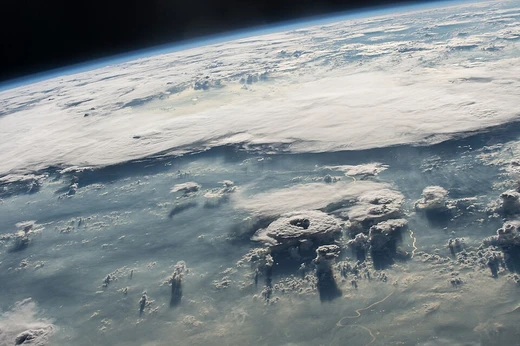
Water vapor
Gaseous phase of water, key to climate and life.
Water vapor, also known as water vapour or aqueous vapor, is the gaseous phase of water and one state of water within the hydrosphere. It is a transparent component of the atmosphere, continuously generated by evaporation and removed by condensation, and is less dense than most other air constituents, triggering convection currents that can lead to clouds and fog. As a key part of Earth’s hydrosphere and hydrologic cycle, water vapor is especially abundant in the atmosphere, where it functions as a greenhouse gas and a warming feedback. It contributes more to the total greenhouse effect than non-condensable gases like carbon dioxide and methane. Because it reacts to temperature changes, water vapor is considered a feedback that amplifies the effects of forces that initially cause warming. The amount of water vapor in Earth’s atmosphere has risen in recent decades, making heavy rainfall events more severe. Beyond Earth, water vapor is a relatively common atmospheric constituent, present in the solar atmosphere, every planet in the Solar System, and many astronomical objects including natural satellites, comets, and large asteroids. Its detection around extrasolar planets would indicate a similar distribution in other planetary systems, and it can serve as indirect evidence for extraterrestrial liquid water. Historically, the use of water vapor as steam has been important for cooking and, since the Industrial Revolution, as a major component in energy production and transport systems. Water vapor is produced from the evaporation or boiling of liquid water or from the sublimation of ice. Evaporation occurs when a water molecule leaves a surface and diffuses into surrounding gas, absorbing kinetic energy in a process called evaporative cooling, which cools the body of water. Sublimation, the direct transition from ice to vapor, accounts for the slow disappearance of snow and ice at temperatures too low for melting, notably in Antarctica where low precipitation allows millennial snow layers to sublime, leaving behind non-volatile materials such as meteorites. Condensation happens when water vapor meets a surface cooler than the dew point or when the vapor equilibrium is exceeded, releasing heat and warming that surface; in the atmosphere, this process produces clouds, fog, and precipitation, typically facilitated by cloud condensation nuclei.
- phase
- Gas
- composition
- H₂O
- role
- Greenhouse gas and warming feedback
- molar_mass
- 18.02 g/mol
- key_processes
- Evaporation, sublimation, condensation
Lore & Background
Water vapor is produced from the evaporation or boiling of liquid water or from the sublimation of ice. It is a relatively common atmospheric constituent, present in Earth's atmosphere, the solar atmosphere, every planet in the Solar System, and many astronomical objects including natural satellites, comets, and large asteroids. Its detection can indicate extraterrestrial liquid water. As a component of Earth's hydrosphere and hydrologic cycle, it acts as a greenhouse gas and warming feedback, contributing more to the total greenhouse effect than non-condensable gases such as carbon dioxide and methane.
Reader's Guide
Water vapor's significance lies in its central role in Earth's climate system and hydrologic cycle. It is the most abundant greenhouse gas, amplifying warming through feedback mechanisms. Its phase changes—evaporation, condensation, and sublimation—drive weather phenomena, including clouds, fog, and precipitation. Historically, the use of water vapor as steam has been crucial for cooking and, since the Industrial Revolution, for energy production and transport. Its measurement, via hygrometers or remote sensing, is vital for weather prediction and climate modeling. Water vapor also participates in chemical reactions, such as rust formation and the curing of certain polymers, and its lower density compared to dry air influences atmospheric buoyancy and convection.
Did You Know?
- Sublimation accounts for the slow mid-winter disappearance of ice and snow at temperatures too low to cause melting, notably in Antarctica.
- Water vapor contributes more to the total greenhouse effect than non-condensable gases such as carbon dioxide and methane.
- Evaporative cooling occurs when liquid water becomes water vapor, taking a parcel of heat with it.
More in Meteorology 1-24
Spotted an error? Know more?
This is a living reference — every entry is fact-audited, and reader corrections feed straight into our audit queue. Suggest an edit · See this site's audit record