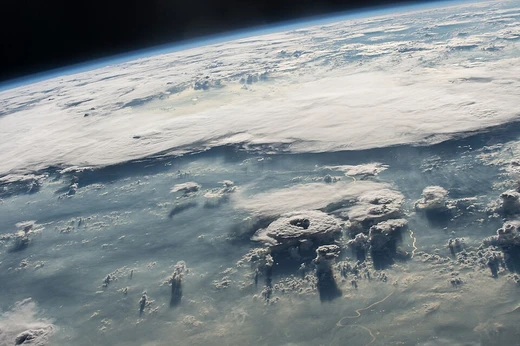
Dry season
Yearly low-rainfall period in the tropics.

Charles J. Sharp · CC BY-SA 4.0
The dry season is a yearly period of low rainfall, especially in the tropics. It is dominated by the movement of the tropical rain belt, which shifts between the northern and southern hemispheres over the course of the year, causing alternating dry and wet periods in tropical regions.
- definition
- A month with average precipitation below 60 millimetres (2.4 in) under the Köppen climate classification
- location
- Tropics, between the Tropic of Cancer and the Tropic of Capricorn
- associated phenomena
- Low humidity, drying of watering holes and rivers, bushfires
- animal migrations
- Zebras, elephants, giraffes, hippos, rhinos, antelopes, wildebeest, and others
- disease link
- Rise in measles cases in Africa during the dry season
Lore & Background
The dry season occurs when the tropical rain belt moves away from a region. From November to March, the rain belt lies in the southern hemisphere, giving the northern tropics a dry season with sparse precipitation and sunny days. From May to September, the rain belt shifts north, bringing a dry season to the southern tropics. Near the Tropic of Cancer and Tropic of Capricorn, there is one wet and one dry season annually; at the equator, the rain belt passes twice a year, producing two wet and two dry seasons.
Reader's Guide
The dry season significantly affects ecosystems and human activity. Low humidity causes watering holes and rivers to dry up, forcing grazing animals such as zebras, elephants, and wildebeest to migrate to more fertile areas. Bushfires become common due to dry vegetation. In Africa, the start of the dry season coincides with a rise in measles cases, possibly because agricultural work becomes impossible without irrigation, leading farmers to move into cities and increasing population density that facilitates disease spread. In the undisturbed parts of the South American Amazon rainforest, foliage growth and coverage increase by about 25% during the dry season, with faster growth; researchers believe this growth helps bring on the wet season by evaporating more water. Ozone levels are also higher in the dry season in the Amazon basin.
Did You Know?
- Under the Köppen climate classification, a dry season month is defined as one with average precipitation below 60 millimetres (2.4 in).
- At the equator, there are two wet and two dry seasons each year because the rain belt passes over twice.
- During the dry season, bushfires are common due to the lack of water in plants.
- In the South American Amazon rainforest, undisturbed areas show about 25% more leaves and faster growth in the dry season.
The Shifting Tropical Rain Belt
The dry season in tropical regions is fundamentally governed by the annual migration of the tropical rain belt. This band of concentrated precipitation oscillates between the two hemispheres over the course of a year. From roughly November through March, it sits over the southern tropics, leaving the northern tropical zones in a period of sparse rainfall and predominantly sunny days. The pattern reverses from May to September, when the belt shifts northward and the southern tropics enter their dry months. Under the Köppen climate classification, a month qualifies as dry in a tropical climate when average precipitation falls below 60 millimetres. The belt extends approximately to the Tropic of Cancer in the north and the Tropic of Capricorn in the south. At these boundary latitudes, regions experience one wet and one dry season per year. At the equator, the belt passes twice annually, producing two wet and two dry seasons. Locations between the tropics and the equator may encounter either a short or a long version of each season, though local geography can substantially alter these patterns. In temperate zones, the functional counterpart to a tropical dry season is simply summer or winter.
Ecological Stress and Animal Migration
When the dry season takes hold, humidity drops sharply, and the consequences cascade through the entire ecosystem. Watering holes and rivers that sustained life through the wet months begin to shrink and eventually dry up entirely. The simultaneous loss of water and the food supply it supported forces a wide range of grazing species to undertake migrations toward more fertile ground. The animals affected span an impressive diversity: zebras, elephants, giraffes, hippos, rhinos, various antelopes, wildebeest, wild water buffaloes, African buffaloes, gaur, tapirs, emus, ostriches, rheas, and kangaroos all face this seasonal pressure. Beyond the animal kingdom, the desiccation of plant material creates conditions ripe for bushfires. With vegetation stripped of its moisture, wildfires become a common and destructive feature of the dry season landscape, reshaping habitats and posing serious threats to both wildlife and the human communities that depend on those ecosystems for their survival.
Population Shifts and Disease Outbreaks
The dry season carries consequences that extend well beyond the natural world into human health. In parts of Africa, epidemiological data reveals a striking correlation: the onset of the dry season coincides with a measurable rise in measles cases. Researchers attribute this pattern to the way the season reshapes human settlement patterns. Without irrigation, agricultural work becomes nearly impossible, prompting farmers to abandon their fields and relocate into cities. This seasonal influx creates dense population hubs where respiratory diseases like measles can transmit far more efficiently than in dispersed rural communities. The mechanism is straightforward—more people packed into closer proximity during a period when outdoor agricultural labor has ceased—yet its public health implications are significant. The dry season thus acts as an invisible driver of disease dynamics, linking climatic cycles to the spread of infectious illness in ways that complicate vaccination and public health planning.
Counterintuitive Amazonian Foliage and Ozone
Recent research into the seasonal portions of the South American Amazon rainforest has produced a finding that defies initial expectation: during the dry season, foliage growth and leaf coverage actually increase, with roughly 25 percent more leaves and a faster rate of growth compared to the wet season. Scientists propose that the Amazon forest itself plays an active role in triggering the arrival of the wet season. By producing additional foliage, the canopy evaporates greater quantities of water, potentially seeding the atmospheric conditions that bring rain. However, this enhanced dry-season growth appears restricted to undisturbed sections of the basin, where tree roots can penetrate deeper into the soil and access stored rainwater from previous seasons. Disturbed areas do not exhibit the same pattern. Additionally, measurements indicate that ozone concentrations in the Amazon basin are substantially higher during the dry season than during the wet season, adding another dimension to the complex atmospheric chemistry that characterizes these two climatic phases.
Gallery
Frequently Asked Questions
What is the dry season?
It is a recurring yearly stretch of minimal rainfall, most prominent in tropical regions. Under the Köppen climate classification, a month is considered part of the dry season when its average precipitation falls below 60 millimetres (2.4 in).
Where does the dry season occur?
It is most characteristic of the tropics, the band of land between the Tropic of Cancer and the Tropic of Capricorn. These regions experience alternating dry and wet periods as the year progresses.
What causes the dry season?
The tropical rain belt shifts northward and southward over the course of the year, following the sun's apparent movement. When this belt moves away from a given tropical area, that region enters its dry phase and receives far less precipitation.
What are the typical effects of the dry season?
Humidity drops, rivers and watering holes shrink or dry up entirely, and the risk of bushfires rises sharply. In parts of Africa, measles cases also tend to spike during this period.
How do animals respond to the dry season?
Large herds of zebras, wildebeest, antelopes, elephants, giraffes, hippos, and rhinos migrate in search of remaining water and grazing. These mass movements are among the most visible consequences of the seasonal rainfall shift.
More in Meteorology 1-24
Elsewhere in the Meteorology universe
Spotted an error? Know more?
This is a living reference — every entry is fact-audited, and reader corrections feed straight into our audit queue. Suggest an edit · See this site's audit record