El Niño–Southern Oscillation
A coupled ocean-atmosphere phenomenon affecting global climate.

via Wikipedia: El Niño–Southern Oscillation · see source
The El Niño–Southern Oscillation (ENSO) is a global climate phenomenon that emerges from variation in winds and sea surface temperatures over the tropical Pacific Ocean. Those variations have an irregular pattern but do have some appearance of cycles. The occurrence of ENSO is not easily predictable. It affects the climate of much of the tropics and subtropics, and has links (teleconnections) to higher-latitude regions of the world. The warming phase of the sea surface temperature is known as "El Niño" and the cooling phase as "La Niña". The Southern Oscillation is the accompanying atmospheric oscillation, which is coupled with the sea temperature change.
- type
- Climate phenomenon
- phases
- Neutral, El Niño, La Niña
- cycle_length
- Typically every two to seven years
- duration
- Lasts a year or so each
- key_mechanism
- Bjerknes feedback (positive feedback)
- first_identified
- Jacob Bjerknes in 1969
- known_for
- Disrupting global weather patterns, causing spikes in global temperature
Verified Timeline
Lore & Background
ENSO describes a quasi-periodic change of both oceanic and atmospheric conditions over the tropical Pacific Ocean. On average, the temperature of the ocean surface in the tropical East Pacific is roughly 8–10 °C cooler than in the tropical West Pacific. Strong trade winds near the equator drive water away from the East Pacific and into the West Pacific. The warm surface waters collect in the western Pacific, deepening the thermocline to an average depth of around 140 m, compared to around 30 m in the East Pacific. The cooler deep ocean water replaces the outgoing surface waters in the East Pacific through upwelling. The northward-flowing Humboldt Current carries colder water from the Southern Ocean to the tropics in the East Pacific. The Bjerknes feedback, named after Jacob Bjerknes in 1969, describes a positive feedback where weaker easterly trade winds result in a surge of warm surface waters to the east and reduced ocean upwelling on the equator, leading to warmer sea surface temperatures (El Niño), a weaker Walker circulation, and even weaker trade winds. Ultimately, the warm waters in the western tropical Pacific are depleted enough so that conditions return to normal. The exact mechanisms that cause the oscillation are unclear and are being studied. An early recorded mention of the term "El Niño" occurred in 1892, when Captain Camilo Carrillo told the geographical society congress in Lima that Peruvian sailors named the warm south-flowing current "El Niño", referring to the Christ Child, because it was most noticeable around Christmas. La Niña ("The Girl" in Spanish) is the colder counterpart of El Niño. In the past, it was also called an anti-El Niño and El Viejo, meaning "the old man".
Reader's Guide
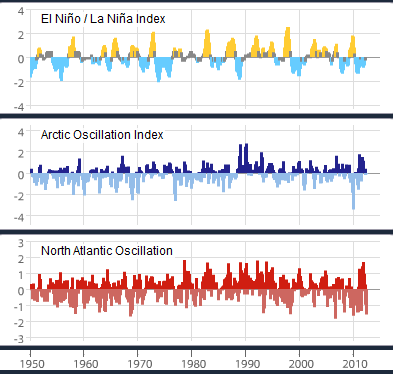
ENSO is known as one of the internal climate variability phenomena. El Niño events cause short-term (approximately one year in length) spikes in global average surface temperature, while La Niña events cause short term surface cooling. Therefore, the relative frequency of El Niño compared to La Niña events can affect global temperature trends on timescales of around ten years. The countries most affected by ENSO are developing countries that are bordering the Pacific Ocean and dependent on agriculture and fishing. Each country that monitors the ENSO has a different threshold for what constitutes an El Niño or La Niña event, which is tailored to their specific interests. Future trends in ENSO due to climate change are uncertain, although climate change exacerbates the effects of droughts and floods. The IPCC Sixth Assessment Report summarized the scientific knowledge in 2021 for the future of ENSO as follows: "In the long term, it is very likely that the precipitation variance related to El Niño–Southern Oscillation will increase". The scientific consensus is also that "it is very likely that rainfall variability related to changes in the strength and spatial extent of ENSO teleconnections will lead to significant changes at regional scale". El Niño and La Niña affect the global climate and disrupt normal weather patterns, which can lead to intense storms in some places and droughts in others.
Did You Know?
- An early recorded mention of the term 'El Niño' occurred in 1892, when Captain Camilo Carrillo told a geographical society congress in Lima that Peruvian sailors named the warm south-flowing current 'El Niño', referring to the Christ Child, because it was most noticeable around Christmas.
- On average, the sea surface temperature in the tropical East Pacific is roughly 8–10 °C cooler than in the tropical West Pacific.
- The thermocline in the western Pacific has an average depth of around 140 m, compared to around 30 m in the East Pacific.
- La Niña was historically also called an anti-El Niño and El Viejo, meaning 'the old man'.
- Each country that monitors ENSO has a different threshold for what constitutes an El Niño or La Niña event, tailored to their specific interests.
The Feedback Engine
The heart of ENSO lies in a self-reinforcing cycle first described by Jacob Bjerknes in 1969. When the easterly trade winds along the equator weaken, warm surface waters that normally pile up in the western Pacific surge eastward. This shift suppresses the cold upwelling that typically keeps eastern Pacific waters cool, and sea surface temperatures climb. The warmer ocean, in turn, weakens the Walker circulation—the large-scale east-to-west atmospheric overturning that normally sustains those trade winds. Weaker winds allow even more warm water to drift east, tightening the positive feedback loop. The oscillation eventually exhausts itself: the warm waters in the western tropical Pacific are depleted enough that conditions gradually revert toward the neutral state. Despite this broadly understood sequence, scientists acknowledge that the exact mechanisms that cause the oscillation are unclear and are being studied. The overall pattern is irregular, showing only some appearance of cycles, and the occurrence of ENSO is not easily predictable.
A Name Born of the Sea
The terminology of ENSO carries centuries of maritime heritage. Peruvian fishermen, working the cold, productive waters off their coast, noticed a warm south-flowing current that became most prominent around the Christmas season. They called it El Niño de Navidad—a nod to the Christ Child. The earliest recorded use of the shortened term in a scientific context came in 1892, when Captain Camilo Carrillo presented to a geographical society congress in Lima, relaying what local sailors had long known. Over time, "El Niño" came to denote the warm, negative phase of the broader oscillation. Its colder counterpart, La Niña ("The Girl"), was historically also called anti-El Niño or El Viejo, meaning "the old man." The "Southern Oscillation" itself refers to the oscillation in surface air pressure between the tropical eastern Pacific Ocean waters and the tropical western Pacific Ocean waters. Notably, no single universal threshold defines an event; each monitoring nation sets its own criteria tailored to local concerns.
Ripples Across the Globe
Although ENSO is rooted in the tropical Pacific, its fingerprints appear across the tropics, subtropics, and even higher-latitude regions through what scientists call teleconnections. During El Niño episodes, sea-level air pressure rises above normal over Indonesia, Australia and across the Indian Ocean to the Atlantic Ocean, while La Niña inverts that pattern, building high pressure over the central and eastern Pacific and lower pressure through much of the rest of the tropics and subtropics. The practical consequences are stark: some regions face intensified storms while others endure severe drought. On a global scale, El Niño produces roughly one-year spikes in average surface temperature, whereas La Niña brings short-term cooling, meaning the balance between the two phases can nudge global temperature trends over roughly a decade. The human toll falls hardest on developing Pacific-rim nations whose livelihoods depend on agriculture and fishing. Individual episodes typically persist about a year, recurring every two to seven years with varying intensity, separated by milder neutral intervals; El Niño events can be more intense, but La Niña events may repeat and last longer.
ENSO in a Warming World
In climate science, ENSO is classified as one of the key internal climate variability phenomena—natural fluctuations distinct from anthropogenic warming. Projecting how it will behave under a changing climate remains genuinely uncertain, though there is broad agreement that climate change exacerbates the effects of droughts and floods that ENSO already triggers. The IPCC's Sixth Assessment Report, published in 2021, distilled the state of knowledge with notable confidence: over the long term, it is very likely that the precipitation variance associated with ENSO will increase. The report further concluded that it is very likely that rainfall variability related to changes in the strength and spatial extent of ENSO teleconnections will lead to significant changes at regional scale. In other words, even if the oscillation's fundamental rhythm persists, the extremes it drives—wet and dry, storm and drought—are expected to grow more pronounced. For the Pacific-rim communities already most vulnerable to these swings, that projection underscores both the urgency of adaptation and the ongoing need to refine the still-uncertain details of how ENSO will evolve.
Gallery
Frequently Asked Questions
Who is El Niño–Southern Oscillation?
ENSO is a coupled ocean-atmosphere climate phenomenon that arises from shifting winds and sea-surface temperatures across the tropical Pacific. It was first formally described by Jacob Bjerknes in 1969, who outlined the positive-feedback loop (the Bjerknes feedback) that drives its behavior.
What are El Niño–Southern Oscillation's powers/role?
ENSO acts as a global climate modulator, altering weather patterns across much of the tropics and subtropics while sending teleconnection signals to higher-latitude regions. Its warming phase is called El Niño and its cooling phase is called La Niña, with a neutral state in between.
What is El Niño–Southern Oscillation's cycle length?
Each full ENSO episode typically lasts around a year, and new episodes tend to recur on an irregular interval of roughly two to seven years. Unlike a strict clock, the exact timing is never perfectly predictable.
How does El Niño–Southern Oscillation's story end?
It doesn't have a final episode—ENSO is an ongoing, repeating cycle rather than a one-time event. Each phase gradually transitions into the next, and the Southern Oscillation's atmospheric pressure seesaw keeps resetting the stage for the following cycle.
Why is El Niño–Southern Oscillation important?
Because its irregular, hard-to-predict swings ripple through ocean and atmosphere simultaneously, ENSO can reshape rainfall, temperature, and storm tracks across continents. Forecasters and climate scientists track it closely since even a single episode can trigger droughts, floods, or shifts in fisheries thousands of miles away.
More in Meteorology 1-24
Related in Meteorology
Links follow this subject's own source article.
Elsewhere in the Meteorology universe
Spotted an error? Know more?
This is a living reference — every entry is fact-audited, and reader corrections feed straight into our audit queue. Suggest an edit · See this site's audit record