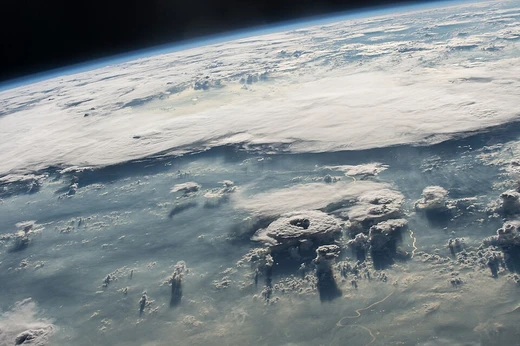
Dew
Atmospheric moisture condensing on cool surfaces as droplets.

Frantisek Malina · CC BY-SA 4.0
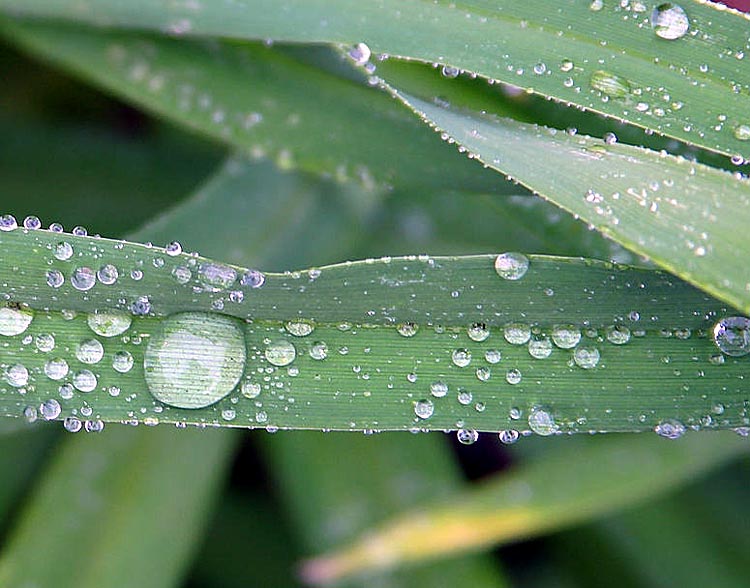
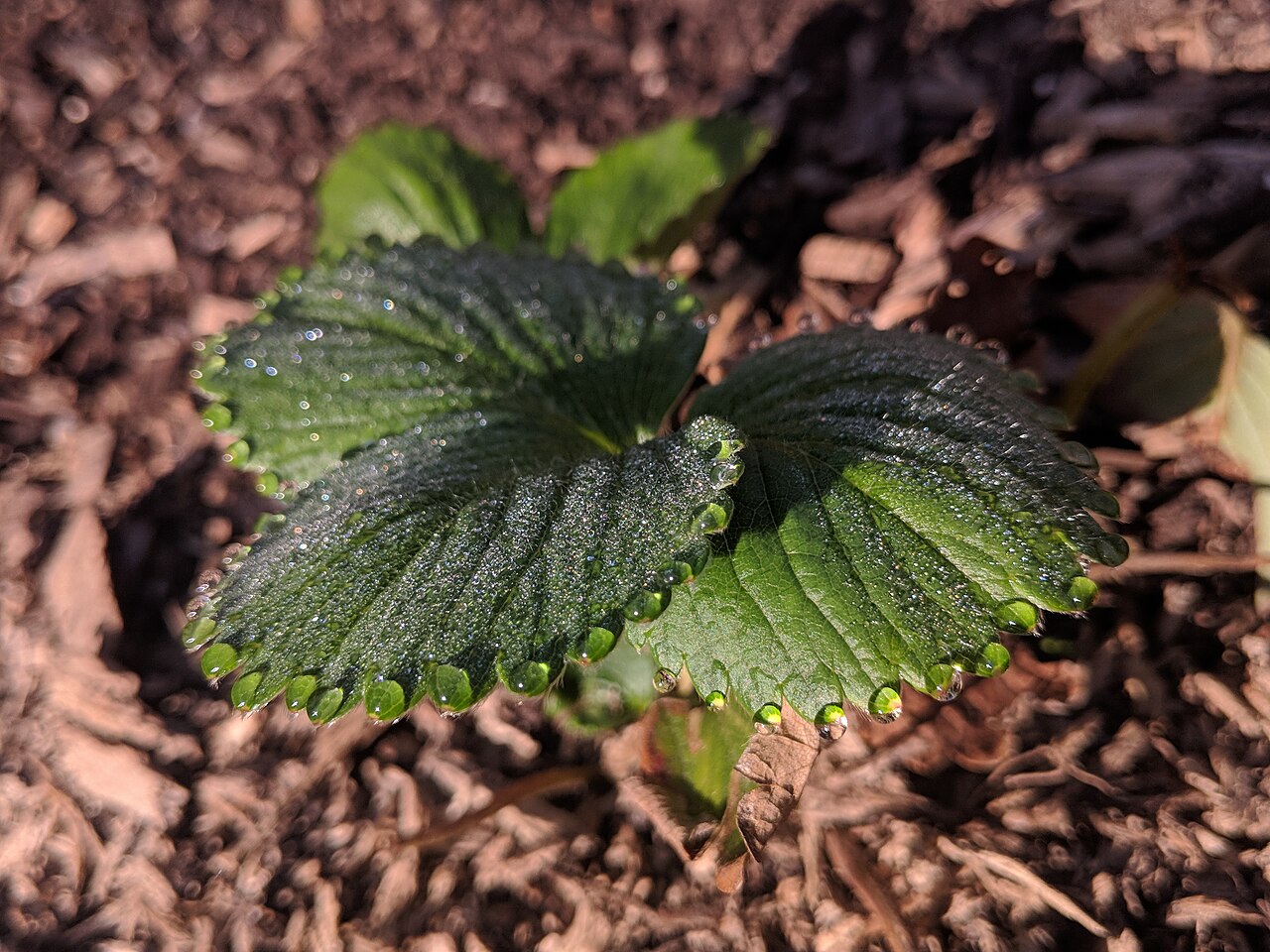
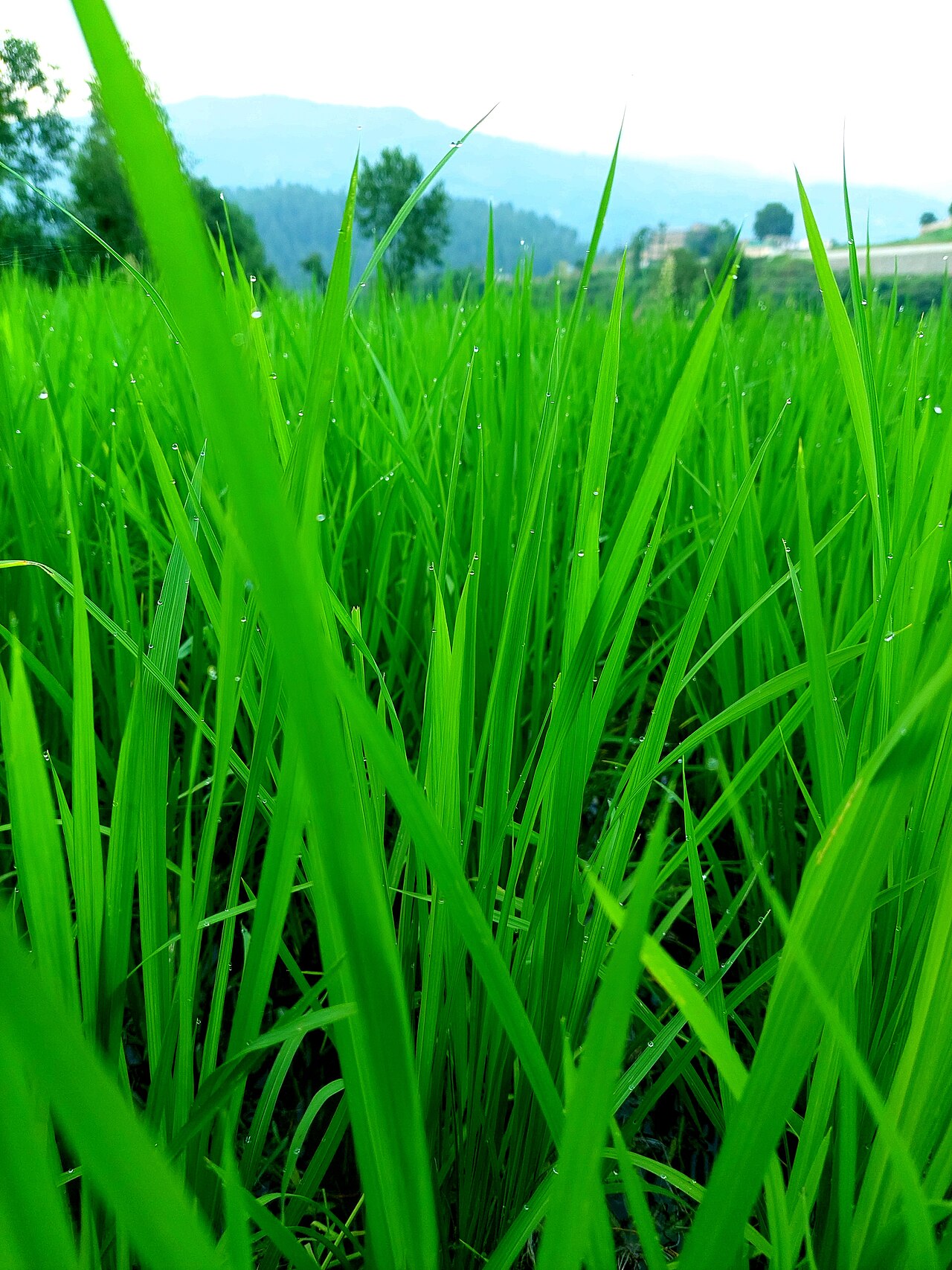
Dew is water in the form of droplets that appears on thin, exposed objects in the morning or evening due to condensation. As the exposed surface cools by radiating its heat, atmospheric moisture condenses at a rate greater than that at which it can evaporate, resulting in the formation of water droplets. When temperatures are low enough, dew takes the form of ice, called frost. Dew is related to the temperature of surfaces, forming most easily on surfaces not warmed by conducted heat from deep ground, such as grass, leaves, railings, car roofs, and bridges.
- Formation
- Condensation on surfaces cooled to the dew point
- Maximum per night
- Theoretical maximum about 0.8 mm; measured rarely exceed 0.5 mm
- Preferred surfaces
- Poor-conducting, non-metallic, well-isolated from ground
- Preferred weather
- Clear nights, calm winds, sufficient humidity near ground
- Measurement device
- Drosometer
- Significant in religion
- Jewish, Christian, and Greek mythology
Lore & Background
Dew forms when a surface cools by radiating its heat, causing atmospheric water vapor to condense into droplets at a rate greater than evaporation. The temperature at which droplets form is called the dew point. This process is distinct from hydrometeors like fog and clouds, which form directly in cooled air, though the thermodynamic principles are the same. Dew is commonly formed at night, evening, and morning. Adequate cooling typically occurs when a surface loses more energy by infrared radiation than it receives from the Sun, especially on clear nights. Poor thermal conductivity restricts replacement of such losses from deeper, warmer ground layers. Preferred objects are poor-conducting or well-isolated from the ground and non-metallic, while shiny-metal-coated surfaces are poor infrared radiators. Calm nights favor dew formation, though some ventilation is needed to replace condensed vapor if the atmosphere is the major moisture source.
Reader's Guide
Dew's significance spans agriculture, religion, and water harvesting. In most climates, annual dew amounts are too small to compare with rainfall, but in dry seasons, adapted plants like lichen or pine seedlings benefit. In the Negev Desert, dew accounts for almost half the water found in three dominant desert species. Dew also hydrates fungal substrates and mycelia, including species that cause blight on potatoes. Historically, the book 'On the Universe' described dew as 'moisture minute in composition falling from a clear sky.' In Greek mythology, Ersa is the goddess of dew. In Judaism, dew (tal) is prayed for between Passover and Sukkot, and appears in midrashim as a tool for resurrection. In the Catholic Mass, the Second Eucharistic Prayer asks the Holy Spirit to come 'like the dewfall.' Artificial harvesting of dew is explored by the International Organization for Dew Utilization (OPUR), with large-scale systems in Kutch, India, harvesting over 200 liters per night for about 90 nights per season. Other schemes propose circulating cold seawater in collectors near seashores.
Did You Know?
- Dew can form as frost when temperatures are low enough.
- A classical device for measuring dew is the drosometer.
- In the Negev Desert, dew provides almost half the water for three dominant plant species.
- The International Organization for Dew Utilization (OPUR) works on foil-based condensers for arid regions.
The Thermodynamic Engine Behind Condensation
The dew point sits at the heart of atmospheric thermodynamics as a precise temperature threshold. Defined as the point at which air, holding a fixed amount of water vapor under constant barometric pressure, reaches full saturation, it is fundamentally a property governed by both the pressure environment and the quantity of moisture suspended in the air. When a parcel of air is cooled and its temperature drops below this threshold, the air's capacity to retain water vapor shrinks, and the excess vapor transitions into liquid water. If that transition happens on contact with a colder solid surface, the resulting droplets are what we call dew. In technical terms, at the dew point the rate at which vapor condenses exactly balances the rate at which liquid evaporates; below it, condensation outpaces evaporation and liquid accumulates. When temperatures fall below the freezing point of water, the analogous threshold is termed the frost point, because ice forms through deposition rather than condensation. In liquid systems, the parallel concept is known as the cloud point. A curious edge case arises when air is cooled past its dew point yet no visible condensation appears—this supersaturated state occurs when the atmosphere lacks sufficient particles to serve as condensation nuclei.
Humidity, Pressure, and the Behavior of Moist Air
The dew point serves as one of the most direct indicators of how much moisture the air actually contains. The more water molecules suspended in a given volume, the higher the dew point climbs, meaning condensation can trigger on surfaces only a few degrees cooler than the surrounding air. In dry conditions, by contrast, the dew point sits far below the ambient temperature, demanding a much greater drop before any liquid forms. At ground level, if all other humidity factors stay constant, relative humidity naturally rises as temperature falls, because cooler air simply cannot hold as much vapor. The dew point equals the air temperature only in the case of complete saturation—100 percent relative humidity—and in every other scenario it remains lower. A useful invariant: if moisture content is held steady while temperature rises, relative humidity drops but the dew point does not shift. Barometric pressure also plays a role; raising pressure elevates the dew point, which means that at higher elevations like Denver, where pressure is lower than in New York City, the same dew point and temperature readings correspond to a greater mass of water vapor per unit volume. In the open atmosphere, condensed water manifests as fog or cloud depending on the altitude at which it forms.
The Body's Relationship with Moisture
Human comfort is intimately tied to the dew point because the body's primary cooling mechanism—evaporation of perspiration—depends entirely on how much moisture the surrounding air can still absorb. When the air is already saturated, sweat simply cannot evaporate, yet the body's thermoregulatory system keeps producing it, leaving a person coated in unevaporated moisture even at rest. Moving air, whether from a natural breeze or a fan, sweeps saturated air away and replaces it with drier air, accelerating evaporation and restoring the cooling effect. A wet-bulb thermometer, which itself relies on evaporative cooling, offers a practical gauge of this comfort dynamic. Discomfort is not one-directional: when the dew point drops below roughly minus five degrees Celsius, the air becomes so dry that skin cracks, airways irritate, and general well-being suffers. The US Occupational Safety and Health Administration recommends indoor conditions of twenty to twenty-four and a half degrees Celsius with twenty to sixty percent relative humidity, which translates to a dew point in the range of about four to sixteen and a half degrees Celsius. Lower dew points below ten degrees Celsius typically pair with cooler ambient temperatures and reduce the body's cooling demand, while a low dew point alongside a high temperature can only occur under extremely low relative humidity, where evaporative cooling remains effective.
Acclimatization, Perception, and Practical Utility
People's tolerance for a given dew point is far from universal. Residents of tropical and subtropical cities such as Singapore or Miami gradually acclimate to persistently high dew points and set their discomfort threshold considerably higher than someone from a temperate locale like London or Chicago, or from an arid desert environment like Riyadh where low dew points are the norm. In temperate regions, many people begin to feel uneasy once the dew point crosses fifteen degrees Celsius, some tolerate up to eighteen, and most consider anything above twenty-one degrees oppressive and tropical in character. Yet inhabitants of hot, humid zones may find that same level perfectly manageable, illustrating that thermal comfort is shaped by both physical environmental variables and psychological adaptation. Beyond personal comfort, the dew point carries significant practical weight. General aviation pilots rely on dew point readings to assess the probability of carburetor icing and fog formation, and to estimate the base altitude of cumuliform clouds. In the summer months, the dew point is widely regarded as the single best predictor of how much energy will be consumed for cooling, with values approaching twenty degrees Celsius producing a near-universal sensation of stickiness.
Gallery



Frequently Asked Questions
What is Dew?
Dew refers to tiny water droplets that collect on exposed surfaces during cool mornings or evenings. It appears when atmospheric moisture condenses onto a surface that has cooled below the dew point through radiative heat loss.
How does Dew form?
A surface radiates its heat outward and cools, causing nearby water vapor to condense into droplets faster than they can evaporate. The key requirement is that the surface temperature drops to or below the dew point of the surrounding air.
What surfaces does Dew form on most easily?
Dew favors poor-conducting, non-metallic surfaces such as grass, leaves, railings, car roofs, and bridges. These materials are well-isolated from the ground's conducted heat, so they cool more effectively and can reach the dew point.
What is the maximum amount of Dew that can form in one night?
The theoretical ceiling sits at roughly 0.8 mm per night, though actual measurements rarely surpass 0.5 mm. This makes Dew a very thin film of water compared to typical rainfall.
What instrument is used to measure Dew?
A drosometer is the dedicated device for quantifying Dew. It captures and measures the condensed droplets on a test surface to determine how much moisture was deposited.
More in Meteorology 1-24
Elsewhere in the Meteorology universe
Spotted an error? Know more?
This is a living reference — every entry is fact-audited, and reader corrections feed straight into our audit queue. Suggest an edit · See this site's audit record