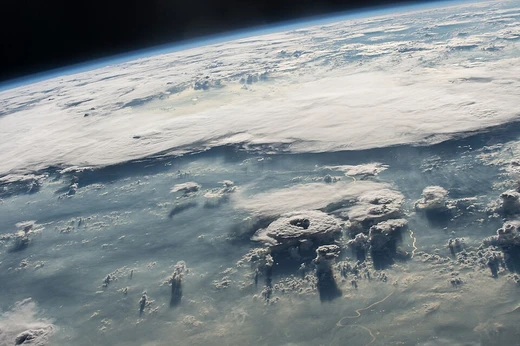
Walker circulation
Conceptual model of tropical zonal and vertical air flow.

The Walker circulation, also known as the Walker cell, is a conceptual model of the air flow in the tropics in the lower atmosphere (troposphere). According to this model, parcels of air follow a closed circulation in the zonal and vertical directions. This circulation, which is roughly consistent with observations, is caused by differences in heat distribution between ocean and land.
- field
- Meteorology
- known_for
- Discovery of the Southern Oscillation and the Walker circulation
- nationality
- British
Lore & Background
Gilbert Walker was an established applied mathematician at the University of Cambridge when he became director-general of observatories in India in 1904. Analyzing vast amounts of weather data from India and the rest of the world, over the next fifteen years he published the first descriptions of the great seesaw oscillation of atmospheric pressure between the Indian and Pacific Ocean, and its correlation to temperature and rainfall patterns across much of the Earth's tropical regions, including India. He also worked with the Indian Meteorological Department especially in linking the monsoon with Southern Oscillation phenomenon. Walker determined that the time scale of a year was unsuitable because geospatial relationships could be entirely different depending on the season. Thus, Walker broke his temporal analysis into December–February, March–May, June–August, and September–November. He selected a number of 'centers of action', which included areas such as the Indian Peninsula. The centers were in the hearts of regions with either permanent or seasonal high and low pressures. He also added points for regions where rainfall, wind or temperature was an important control. He examined the relationships of the summer and winter values of pressure and rainfall, first focusing on summer and winter values, and later extending his work to the spring and autumn. Walker concluded that variations in temperature are generally governed by variations in pressure and rainfall. It had previously been suggested that sunspots could be the cause of the temperature variations, but Walker argued against this conclusion by showing monthly correlations of sunspots with temperature, winds, cloud cover, and rain that were inconsistent. Walker made it a point to publish all of his correlation findings, both of relationships found to be important as well as relationships that were found to be unimportant, to dissuade researchers from focusing on correlations that did not exist.
Reader's Guide
The Walker circulation is a foundational concept in tropical meteorology, linking atmospheric pressure gradients, ocean temperature asymmetries, and wind patterns across the equatorial Pacific, Atlantic, and Indian basins. It is associated with the pressure gradient force resulting from a high pressure system over the eastern Pacific Ocean and a low pressure system over Indonesia. The circulation causes westerly surface winds in northern summer in the Indian basin and easterly winds in the Pacific and Atlantic basins, leading to dramatic asymmetries in ocean surface temperature and thermocline depth. Changes in the Walker circulation occur in conjunction with changes in surface temperature, some forced externally (e.g., seasonal solar shifts) and others through coupled ocean-atmosphere feedback, as originally proposed by Bjerknes. During El Niño events, the circulation weakens, reducing the temperature gradient and easterlies; during La Niña, it strengthens. The circulation is indirectly related to upwelling off the coasts of Peru and Ecuador, bringing nutrient-rich cold water to the surface and increasing fishing stocks.
Did You Know?
- The Walker circulation is associated with a high pressure system over the eastern Pacific and a low pressure system over Indonesia.
More in Meteorology 25-38
Elsewhere in the Meteorology universe
Spotted an error? Know more?
This is a living reference — every entry is fact-audited, and reader corrections feed straight into our audit queue. Suggest an edit · See this site's audit record