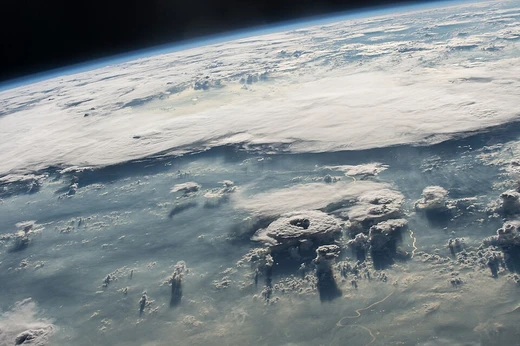
Summer
Hottest temperate season, with longest days near the solstice.

Txllxt TxllxT · CC BY-SA 4.0
Summer or summertime is the hottest and brightest of the four temperate seasons, occurring after spring and before autumn. At or centered on the summer solstice, daylight hours are the longest and darkness hours are the shortest, with day length decreasing as the season progresses after the solstice. The earliest sunrises and latest sunsets also occur near the date of the solstice. The date of the beginning of summer varies according to definition, climate, tradition, and culture. When it is summer in the Northern Hemisphere, it is winter in the Southern Hemisphere, and vice versa.
- Etymology
- Modern English summer derives from Middle English somer, via Old English sumor.
- Meteorological definition (Northern Hemi
- June, July, August
- Meteorological definition (Southern Hemi
- December, January, February
- Astronomical start (Northern Hemisphere)
- Summer solstice (usually 20 or 21 June)
- Astronomical end (Northern Hemisphere)
- Autumn equinox
- Cultural start (US)
- Memorial Day weekend (last weekend in May)
- Cultural end (US)
- Labor Day (first Monday in September)
Lore & Background
The modern English word 'summer' comes from Middle English 'somer', via Old English 'sumor'. Meteorological reckoning defines summer as June, July, August in the Northern Hemisphere and December, January, February in the Southern Hemisphere, aligning with the commonly viewed notion of summer as the season with the longest and warmest days. This definition is used in countries including Australia, New Zealand, Austria, Denmark, Russia, Japan, and by many in the United Kingdom and Canada. In Ireland, Met Éireann uses June, July, and August.
Reader's Guide
Summer's significance lies in its role as the warmest and brightest season, shaping agriculture, culture, and daily life across the globe. Its definition varies widely: meteorological conventions set fixed calendar months, while astronomical reckoning ties it to solstices and equinoxes. Cultural traditions further diversify its start and end, such as the US Memorial Day to Labor Day period, or the Gaelic festival of Bealtaine on 1 May. In the Southern Hemisphere, summer coincides with Christmas and New Year holidays. The season also governs natural phenomena like tropical cyclone seasons in the Atlantic (1 June to 30 November) and thunderstorm seasons in North America. School breaks worldwide align with summer, reflecting its impact on education and family travel. The article notes that the meteorological midpoint, based on average temperature patterns, occurs weeks after maximal insolation due to seasonal lag.
Did You Know?
- The modern English word 'summer' derives from Middle English 'somer', via Old English 'sumor'.
- In the Northern Hemisphere, meteorological summer comprises June, July, and August; in the Southern Hemisphere, it comprises December, January, and February.
- In Gaelic Ireland and Scotland, summer began with the festival of Bealtaine on 1 May and ended with Lughnasa on 1 August.
- The Atlantic hurricane season runs from 1 June to 30 November, with a statistical peak on 10 September.
The Many Calendars of Summer
Summer resists a single universal definition. Meteorological convention, adopted by nations including Australia, New Zealand, Austria, Denmark, Russia, and Japan, simply assigns the season to three calendar months—June through August in the north, December through February in the south—so that every season begins and ends on a month boundary. This neat arithmetic, however, sits in tension with the physical reality it describes: daylight actually peaks at the solstice, meaning the true midpoint of maximum sun falls roughly in the middle of the meteorological block rather than at its start. Astronomical reckoning offers a different anchor, sometimes placing summer's beginning at the solstice itself (around 20 or 21 June in the Northern Hemisphere) and its end at the autumn equinox. A third approach, rooted in solar terms, pushes the start even earlier, to roughly 5 May, treating the solstice as Midsummer rather than the opening moment. Which of these frameworks a community adopts depends on climate, tradition, and cultural heritage, making the season's boundaries as fluid as the weather itself.
Cultural Roots and Festivals
Across civilizations, the arrival of summer has been marked by festivals, calendar reforms, and deeply embedded traditions. In the ancient Roman world, the Julian calendar placed summer's start on 9 May, with the solstice on 24 June as its midpoint and its close on 10 August. Anglo-Saxon England followed a nearly identical pattern, and 24 June endured for centuries as Midsummer Day, one of the four quarter days that divided the English year. In Gaelic Ireland and Scotland, the season opened with Bealtaine on 1 May and closed with Lughnasa on 1 August, while Welsh tradition anchored it to Cyntefin, or Calan Haf, literally the first of summer, also on 1 May. Chinese astronomy introduces the solar term lìxià, the establishment of summer, around 5 May, and marks its end with lìqiū near 7 August. In the modern United States, summer is culturally bounded by Memorial Day weekend and Labor Day, a span that mirrors the meteorological definition. In Southern Hemisphere nations like Brazil, Argentina, and South Africa, the season is inseparable from Christmas and New Year celebrations, with families taking extended holidays of two or three weeks or more.
The Science of Longest Days
Summer's defining physical feature is the behavior of daylight. At or around the solstice, days reach their maximum length and nights their minimum, with the earliest sunrises and latest sunsets clustering near that date. After the solstice passes, daylight hours steadily contract, so the season actually encompasses a build-up toward the longest day followed by a gradual shortening. This means that if one reckons seasons purely by hours of light, the solstice marks the midpoint rather than the beginning. A further complication arises from what is called seasonal lag: because the atmosphere and landmasses take time to absorb and release heat, the peak of average temperature typically arrives several weeks after the peak of solar insolation. In the oceanic temperate southern hemisphere, this lag is shorter, which is why most countries there simply adopt the meteorological three-month window. The word itself carries a long linguistic lineage, tracing from modern English summer back through Middle English somer to Old English sumor, a thread stretching over a millennium.
Summer's Weather and Storms
Summer's atmospheric character varies dramatically by region and climate zone. In Mediterranean areas, the season is defined by intense heat combined with prolonged dryness, a pattern that shapes agriculture and daily life. In stark contrast, much of Eastern Asia experiences summer as the wettest period of the year, driven by the monsoon—a seasonal shift in prevailing winds that delivers the main growing season for savanna ecosystems. In southern and southeast Asia, summer is broadly understood as the warm stretch from March through June, ending when monsoon rains finally arrive. Tropical cyclone activity is also tightly linked to the summer months. The Atlantic hurricane season runs from 1 June to 30 November, with its statistical peak on 10 September. The Northeast Pacific follows a similar window, while the Northwest Pacific sees storms year-round, peaking in early September. In the North Indian basin, cyclones are most frequent from April through December, with peaks in May and November. In the Southern Hemisphere, the cyclone season spans from early November to late April, overlapping the local summer and winter months.
Gallery

Frequently Asked Questions
What is Summer in meteorology?
Summer is the warmest and brightest of the four temperate seasons, falling between spring and autumn. It is characterized by peak temperatures and the longest stretch of daylight in the annual cycle.
When exactly does Summer begin and end?
The start date depends on which definition you follow: meteorologically it runs June through August in the Northern Hemisphere (December–February in the South), astronomically it begins at the summer solstice around June 20–21 and ends at the autumn equinox, and culturally in the U.S. it is often marked by Memorial Day weekend in late May.
What makes the solstice period special during Summer?
Around the summer solstice, daylight reaches its maximum length while nighttime hits its minimum, and the earliest sunrises and latest sunsets cluster near that date. After the solstice passes, days gradually shorten as the season moves toward autumn.
How does Summer work differently in the Southern Hemisphere?
Because the two hemispheres experience opposite seasons simultaneously, when the Northern Hemisphere is in its hot summer months, the Southern Hemisphere is in winter, and vice versa. Meteorological summer in the South therefore spans December, January, and February.
Where does the word 'Summer' come from?
The modern English word traces back through Middle English 'somer' to Old English 'sumor,' making it one of the oldest inherited season names in the language.
More in Meteorology 25-38
Elsewhere in the Meteorology universe
Spotted an error? Know more?
This is a living reference — every entry is fact-audited, and reader corrections feed straight into our audit queue. Suggest an edit · See this site's audit record